

Search “best healing retreats in Bali” and you’ll get roughly the same ranked list everywhere – ten properties, a paragraph each, mostly reading like it was copied from each one’s own press page. That list will be a different ten by the time you actually book, because retreat centres open, close, rebrand and change hands constantly.
What doesn’t change nearly as fast are the handful of genuinely different models these retreats operate on. Understanding those models lets you evaluate whatever’s actually open and available when you’re ready to book, rather than trusting a list that’s already half out of date.
What makes a good healing retreat, beyond the marketing
A good healing retreat gives you two things in the right proportion: enough structure that you’re not just on an unusually nice holiday, and enough unstructured time that healing has room to actually happen rather than being scheduled into forty-five-minute slots. Retreats that get this balance wrong tend to err toward over-programming – back-to-back sessions that leave guests as depleted as they arrived, just in a nicer setting.
The main categories of healing retreat in Bali
Large resort-style programmes. Multi-day packages at bigger wellness resorts, usually with a fixed sequence of treatments, ceremonies and classes bundled into the price. The appeal is genuine: no decisions required, a full team of practitioners, and often five-star accommodation alongside the programme. The trade-off is a fixed schedule that doesn’t flex around what you personally need on any given day.
Single-session healing. A two-hour appointment with a traditional healer, usually booked as a standalone experience while staying elsewhere. Good for sampling the tradition without committing days to it; less suited to anyone processing something that genuinely needs more than an afternoon.
Boutique private-villa stays. A private villa or small villa complex where healing elements – yoga, ceremony, therapy – are available on request rather than scheduled for you. This model trades the reassurance of a fixed programme for genuine privacy and pacing control.
Beachfront wellness resorts. Larger properties combining spa treatments with a beach or coastal setting, often positioned toward relaxation as much as deep healing work. A reasonable choice for guests who want the wellness framing without the more intensive ceremonial or therapeutic elements.
How to choose the right category for you
If you’ve never done anything like this before and want the decisions made for you, a large resort-style programme removes almost all the guesswork. If you’re curious but short on time, a single session is a reasonable taste of the tradition. If you’re processing something specific – grief, burnout, a major transition – and suspect you’ll need privacy and flexible pacing more than a fixed schedule, the boutique private-villa model tends to suit better. If relaxation matters as much as depth, a beachfront wellness resort may be the most comfortable fit.
What to expect when you arrive
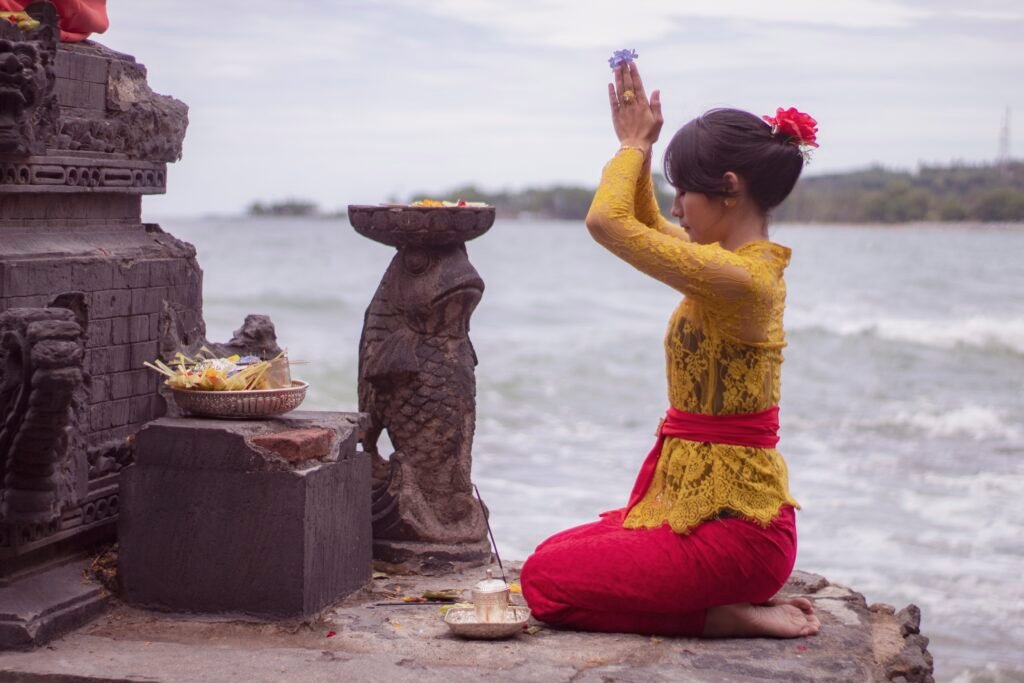
Regardless of category, most healing retreats begin with some form of intake – a conversation about what you’re hoping to get from the stay, sometimes a brief assessment from a practitioner. From there, expect some combination of yoga or movement, meditation, a ceremonial or ritual element specific to Balinese tradition, nourishing food, and rest. The proportion of each varies enormously by category and property.
How long should a healing retreat last?
Three nights is a realistic minimum to properly decompress from travel and daily life before any deeper work begins. Five to seven nights tends to be where most guests report a genuine shift. Anything shorter risks functioning more as a nice holiday than an actual retreat, whatever the marketing calls it.
Budgeting for a healing retreat in 2026
Single sessions typically run from around £30 to £80 depending on the practitioner and treatment. Large resort-style multi-day programmes commonly range from £150 to £400 per night, often inclusive of meals and the full programme. Boutique private-villa stays tend to sit lower, particularly when booked directly rather than through a packaged programme, since you’re paying for accommodation plus optional add-ons rather than a bundled all-inclusive rate.
Spotlight: a boutique private-villa healing retreat in Lovina
Taman Ganesha, a six-villa complex in North Bali, is a fairly direct example of the boutique private-villa model described above. Guests build their own stay from private yoga, an optional Melukat ceremony at the property’s own holy water temple, and as much unstructured time as they want, rather than following a fixed daily itinerary. It’s a genuinely different proposition from the packaged-programme model that dominates most search results for this topic.
Frequently asked questions
What is the best type of healing retreat in Bali?
It depends entirely on what you need. Structured resort programmes suit first-timers wanting guidance; boutique private-villa stays suit guests wanting privacy and flexible pacing; single sessions suit anyone curious but short on time.
How much does a healing retreat cost in Bali?
Single sessions typically cost £30 to £80. Multi-day resort-style programmes commonly run £150 to £400 per night inclusive. Boutique private-villa stays tend to be more affordable, particularly booked directly.
How long should a healing retreat be?
Three nights is a reasonable minimum. Five to seven nights is where most guests report a more significant shift, since it allows time to properly decompress before any deeper work begins.
Choosing what’s actually right for you
The best healing retreat in Bali isn’t a specific named property – it’s whichever model actually matches what you need right now, which is a more useful question than any ranked list can really answer.
➤ Explore healing retreats at Taman Ganesha See how the boutique private-villa model works in Lovina. Learn more.