

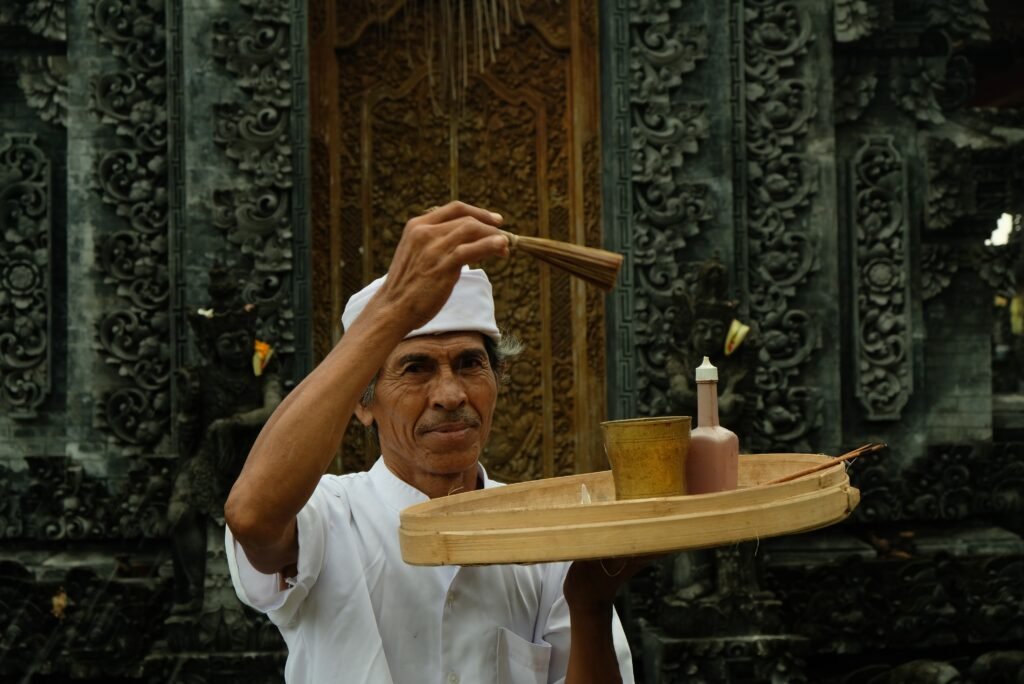
Search “Bali spiritual healing” and most of what comes back is a single booked session: an hour or two with a healer in Ubud or Kerobokan, a palm reading, a chakra realignment, then back to your hotel by lunchtime. Reviews for these sessions range from genuinely moving to, in a few cases, openly disappointing – a wide enough spread that it’s worth understanding what you’re actually booking before you commit to one.
This guide covers the whole landscape properly: what Melukat actually involves, the tradition behind it, the difference between a single session and a longer retreat built around healing, and how to tell which one you actually need.
Why Bali is considered a healing island
Bali’s reputation didn’t arrive with Eat, Pray, Love, though the book didn’t hurt. Balinese Hindu culture treats the spiritual and physical as inseparable – daily offerings placed on doorsteps and shopfronts each morning, temple ceremonies that pause entire streets without complaint, family healer lineages passed down for generations. None of it is staged for tourists; it continues whether or not anyone’s watching.
That existing depth is why global wellness travel keeps returning to the island rather than manufacturing something similar elsewhere. Spiritual retreats have been named one of the fastest-growing wellness travel categories for 2026, and Indonesia – with Bali doing most of the heavy lifting – regularly ranks among the world’s leading wellness destinations as a result.
What ‘spiritual healing’ actually means, beyond the phrase
The phrase gets used loosely enough to cover almost anything from a sound bath to a full ceremonial purification. In Bali specifically, it usually points to Balinese Hindu practice: rituals aimed at releasing mala – accumulated spiritual impurity, whether from daily life, grief, or unresolved experience – through prayer, offerings and holy water.
It’s less a single treatment than an ongoing practice woven into Balinese daily life, which Western travellers usually only sample in a single, concentrated dose. Even that once counted as unusually alternative territory outside Bali; by 2026, full moon ceremonies and sound baths have become fairly ordinary spa-menu items, which says more about where global wellness culture has moved than about Bali itself.
Melukat – the water purification ceremony, properly explained
Melukat is the specific ritual most people mean when they search for spiritual healing in Bali, and it’s worth explaining properly rather than reducing it to “a spiritual bath.”
The word comes from the Balinese lukat, to purify. The ceremony works on two layers simultaneously: sekala, the physical and visible, and niskala, the spiritual and unseen. Holy water – tirta – is the medium for both. In many ceremonies, a priest creates tirta by chanting mantras over clean water drawn from a sacred spring; Bali’s water temples exist specifically because certain springs are considered natural sources of it.
A typical Melukat sequence runs roughly like this: an offering is presented, often with the sound of a bell; prayers are recited, invoking the spring or temple’s particular energy; the holy water is poured or sipped as a blessing; and the participant is immersed in or doused with the water itself, sometimes concluding with a protective bracelet tied at the wrist. Sarongs and sashes are worn throughout, out of respect rather than formality for its own sake.
What guests report afterwards varies, understandably, from person to person. Lightness is the word that comes up most often – a sense of having set something down rather than simply relaxed. Whether that’s spiritual, physiological, or some combination of both isn’t really the point; the ritual has been practised for generations regardless of how a Western visitor chooses to interpret it.
The Balian tradition – Bali’s traditional healers
Most single-session spiritual healing bookings in Bali involve a Balian – a traditional healer, distinct from a Pedanda (high priest) – who practises everything from energy work and chakra balancing to palm reading and what’s sometimes described, less formally, as removing bad energy. The tradition is centuries old and rooted in lontar usada, palm-leaf manuscripts recording Balinese medical and spiritual knowledge.
The honest caveat: quality varies considerably. Some Balian sessions are genuinely moving experiences led by healers with real lineage and training. Others, particularly in more touristed areas, lean harder into performance than practice. Reading recent reviews before booking any individual session is worth the ten minutes it takes, and asking your accommodation for a personal recommendation tends to produce better results than a walk-in booking near a beach club.
Ganesha’s place in all of this
Ganesha appears constantly across Bali, in temple carvings, roadside shrines and property names, and it’s worth understanding why. In Hindu tradition, Ganesha is the remover of obstacles – invoked at the start of any significant undertaking, journey, or difficult passage, precisely because obstacles are assumed to exist and need active clearing rather than hoping they resolve themselves. That’s a different framing from the instinct to power through difficulty alone. It’s also, not coincidentally, the reason a great many Bali retreat properties carry some version of the name – Ganesha isn’t decoration; the name is a stated intention.
A single session, or something longer – what to actually look for
Here’s the part most guides don’t address directly: a one-hour Balian session and a multi-day spiritual retreat are solving genuinely different problems, and conflating them leads to disappointment either way.
A single session suits someone curious to sample the experience, short on time, or already staying elsewhere in Bali for a different reason. It’s a concentrated dose – powerful for some people, underwhelming for others precisely because an hour rarely holds enough space for whatever actually needs releasing.
A longer stay built around spiritual healing – days rather than hours, with the ceremony as one part of a broader rhythm of rest, privacy and reflection – tends to suit anyone processing something with real weight: grief, a major transition, sustained burnout. The ceremony matters less in isolation than as part of the surrounding quiet that gives it somewhere to land.
Neither is wrong. But if you’ve booked a single hour hoping it will resolve something that’s been building for years, it’s worth adjusting the expectation before you go, not after.
North Bali versus Ubud for spiritual healing
Most spiritual healing experiences that rank well online sit in or around Ubud, which has genuine advantages: an enormous concentration of healers, easy access, decades of established wellness infrastructure. It’s also, by 2026, considerably busier than the version of Ubud that first built that reputation.
Lovina, on Bali’s north coast, offers a quieter version of the same spiritual depth without the crowds – fewer healers to choose from, certainly, but also fewer decisions to overthink, and a slower daily rhythm that arguably suits the reflective work of spiritual healing better than a town with a yoga studio on every corner.
Spotlight: the holy water temple at Taman Ganesha, Lovina
During a garden expansion in 2023, a work crew clearing an old fish pond at Taman Ganesha uncovered a natural spring and the remains of a forgotten water temple built around it. Local spiritual leaders recognised the site’s significance immediately, and it was restored – the spring now flows again toward the property’s ancient sacred tree and the surrounding rice fields, open to guests and the local community alike.
The discovery arrived a year after Robert and Sue became the property’s custodians, having arrived in Bali on the tenth anniversary of the passing of their son Ryan – whose childhood nickname, given for his distinctive ears, was “Ganesh.” They’d known almost nothing about the property before viewing it. Its name already matched.
Guests can arrange a Melukat ceremony at the temple, led by a local priest, either as an individual booking or as part of a retreat group’s opening or closing ritual. The property’s six private pool villas surround a shared shala garden a short walk from the temple, giving guests the rare combination of an authentic ceremony and days of genuine privacy afterwards to let it settle – rather than a ceremony followed immediately by a drive back to a hotel.
How to arrange a healing experience respectfully
A few practical notes, regardless of where you book. Bring or borrow a sarong and sash – most properties and temples provide these if you don’t have your own. Use your right hand for offerings and keep your head lower than any officiating priest during blessings, both signs of respect within Balinese custom. Menstruating women are traditionally asked not to participate in certain temple ceremonies; ask ahead if this applies to you, and a good operator will simply offer an alternative without making it awkward. Book ahead where possible – the more respected healers and priests are often genuinely busy, not artificially scarce for marketing effect.
Frequently asked questions
What is spiritual healing in Bali?
Spiritual healing in Bali generally refers to Balinese Hindu practices, most commonly the Melukat water purification ceremony, aimed at releasing accumulated spiritual and emotional imbalance through holy water, prayer and ritual guided by a priest or traditional healer.
What is Melukat and how is it done?
Melukat is a purification ceremony using holy water, or tirta, typically performed at a spring or temple. A priest leads prayers and offerings before the participant is immersed in or blessed with the water, addressing both the physical (sekala) and spiritual (niskala) layers of wellbeing.
Is Bali known for healing?
Yes. Balinese Hindu culture treats spiritual and physical wellbeing as inseparable, expressed daily through offerings, temple ritual and generations of traditional healers. That existing depth, rather than any recent marketing push, is why the island remains a genuine centre for spiritual and wellness travel.
What’s the difference between healing and wellness retreats?
Wellness tends to focus on the measurable: yoga, diet, sleep, movement. Spiritual healing addresses what’s harder to quantify – grief, transition, unresolved experience. Many retreats, including private villa stays, blend both rather than choosing one.
What is the significance of Ganesha in Bali?
Ganesha is revered as the remover of obstacles, invoked at the start of journeys, undertakings and difficult passages. The name appears widely across Bali’s temples, shrines and retreat properties as a stated intention rather than decoration.
How do I find an authentic Balinese healer?
Ask your accommodation for a personal recommendation rather than booking the first listing you find near a tourist area, and read recent reviews carefully – quality varies significantly. Established retreat properties with an ongoing relationship to a local priest or healer tend to offer more consistent experiences than one-off walk-in bookings.
Where this leaves you
Neither the single session nor the longer stay is the objectively correct choice – it depends entirely on what you’re actually carrying and how much time you’re willing to give it. If you’re curious rather than carrying something heavy, an afternoon session is a genuinely worthwhile taste of Balinese tradition. If you suspect an hour won’t be enough, it probably won’t be, and a longer stay built around the ceremony – rather than squeezed around it – is worth the extra planning.
➤ Explore spiritual healing at Taman Ganesha A holy water temple, six private villas, and the story behind the name. Read more.